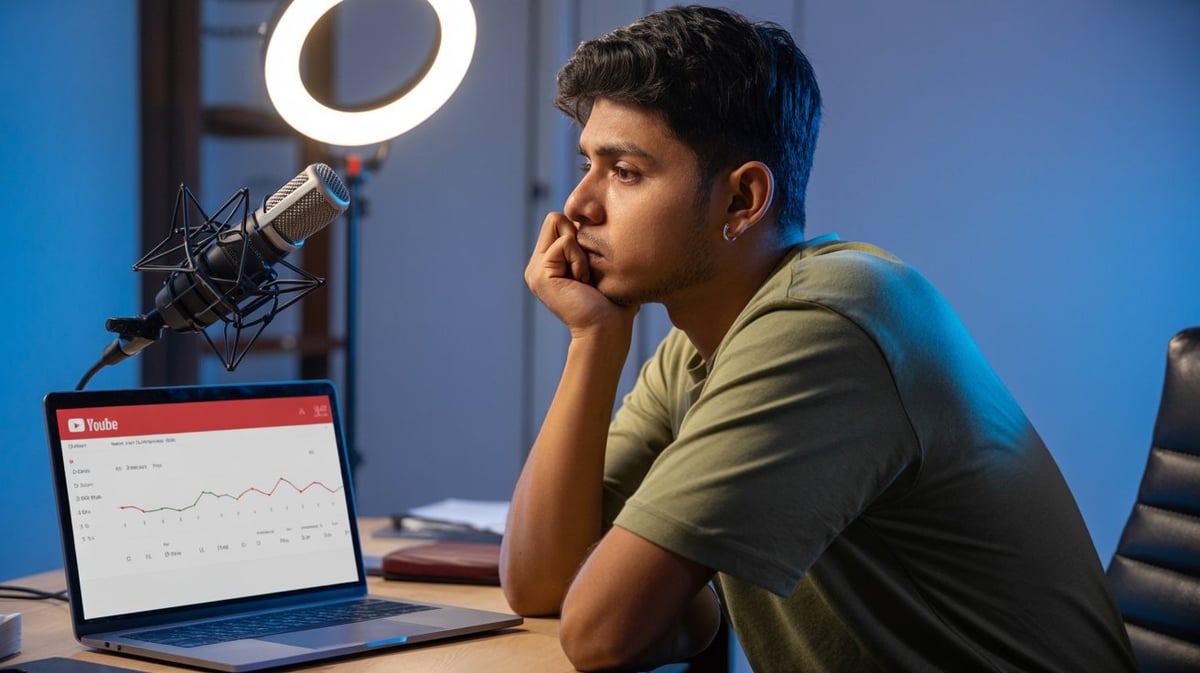
You spent 8 hours editing a video. You picked the perfect thumbnail. You wrote a catchy title. You uploaded it, shared it on Facebook, sent it to your friends on WhatsApp.
24 hours later: 23 views. 4 likes. 1 comment (from your mother).
Meanwhile, your cousin's random 30-second cat video hit 5,000 views. What is going on?
The Algorithm Does Not Care About Your Effort
Here is the hard truth. YouTube does not decide what to show people based on how long you spent editing. It decides based on signals. And the most important signals happen in the first 24 to 48 hours after you upload.
The algorithm looks at a few things early on:
Click-through rate. When your video appears in someone's feed, do they click on it? A good thumbnail and title help here.
Watch time. Once someone clicks, do they actually watch? Or do they leave after 10 seconds? Longer watch time tells YouTube the video is worth recommending.
Engagement rate. Are people liking, commenting, and subscribing after watching? This tells YouTube that viewers care about your content.
Early momentum. This is the big one. If your video gets strong engagement in the first 24 to 48 hours, YouTube starts testing it with a wider audience. If nobody watches it in the first two days, it gets buried.
That last point is where new channels have the biggest problem.
The Cold-Start Problem
When you have 50 subscribers, your video goes out to maybe 20 of them. If 5 watch it, that is your initial data. YouTube looks at that and thinks, "Not much interest here." So it does not recommend your video to anyone else.
Big channels do not have this problem. When a channel with 100,000 subscribers uploads, thousands of people watch it within hours. The algorithm has lots of data to work with. It starts recommending the video within a day.
For new channels, you are stuck in a loop. You need views to get recommended. But you need to get recommended to get views.
This is called the cold-start problem. And it is the number one reason new YouTube channels feel invisible.
Why Good Content Alone Is Not Enough
A lot of creators think: if I just make better content, people will find me. And that is partially true. But here is the problem.
YouTube will never show your content to people if it does not have data proving it is worth showing. The algorithm needs proof. And to get that proof, real people need to watch it first.
You can make the most valuable cooking tutorial in Bangladesh, but if your first 50 subscribers only have 3 active viewers among them, YouTube has no reason to push it to anyone new. Your channel is invisible, not because the content is bad, but because the algorithm has no evidence it is good.
This is why so many talented creators in Bangladesh quit before ever finding their audience. They assume the content was not good enough. Sometimes it was the cold-start problem all along.
Where Micro-Tasks Come In
This is where platforms like MicroJob can help. And I do not mean "buy fake subscribers." Let me explain the difference.
When you post a task on MicroJob asking people to subscribe to your channel, watch your video, and leave a comment, real people do it. Not bots. Not click farms. Real users with real YouTube accounts who actually watch your content and engage.
Here is what that does for you:
Breaks the cold-start loop. Instead of 5 people seeing your video in the first 24 hours, you get 50 to 100. The algorithm suddenly has enough data to start testing your video with a wider audience.
Gives you real comments. Comments are one of the strongest engagement signals. When YouTube sees 20 comments on a new video from a small channel, it takes notice.
Builds your subscriber base. Getting from 0 to 200 subscribers is the hardest part. After 200, organic growth starts to kick in because the algorithm has a bigger initial audience to test with.
What Works vs. What Does Not
Not all engagement is equal. Here is what actually helps your channel:
What works:
Real people watching your video for at least 30 seconds to 1 minute (watch time matters)
Genuine comments that mention something about the video (the algorithm can detect generic spam)
Subscribers who occasionally come back (YouTube tracks subscriber engagement over time)
Engagement spread over a few days (a sudden spike of 1,000 subscribers in 1 hour looks suspicious)
What does not work:
Empty follows from accounts that never watch anything
Copy-paste comments like "Nice video!" on every video (YouTube filters these)
Buying thousands of subscribers in one batch (can get your channel flagged)
This is why MicroJob's proof system matters. When you require workers to submit screenshots showing they actually watched, commented, and subscribed, you get real engagement. Not empty numbers.
Writing a Job Post That Gets Quality Results
How you write your task description makes a big difference in the quality of engagement you get back. Here are a few tips:
Be specific about what you want. Instead of "subscribe to my channel," write "subscribe to my channel AND watch this video for at least 2 minutes AND leave a genuine comment about the video content."
Give context about your channel. Tell workers what your channel is about. A worker who knows your channel is about cooking in Dhaka will leave a better comment than someone who does not know anything about you.
Set clear proof requirements. Ask for a screenshot of the subscription confirmation AND a screenshot of the comment they left. Two screenshots means two confirmations.
Do not rush workers. Give a reasonable deadline. If you push people to finish in 2 hours, quality drops. 24 to 48 hours is a good window.
Reject clearly bad submissions. If someone sends a generic "nice video" comment, reject it and write a clear reason. The platform has a disputes system if needed. Your standards protect your channel.
A Realistic Growth Plan
Here is a practical plan for a new Bangladeshi YouTube channel:
Month 1: Build the foundation
Upload 8 to 10 quality videos (2 to 3 per week)
Use MicroJob to get your first 200 subscribers. Budget: about ৳4,000 to ৳5,000.
For each new video, post a task for 50 people to watch and comment. Budget: about ৳2,000 per video.
Month 2: Feed the algorithm
Keep uploading consistently
Use micro-tasks for the first 2 days after each upload to give the algorithm early signals
Start tracking which videos get recommended organically
Reduce task spending as organic growth picks up
Month 3 and beyond: Scale what works
By now you should see some videos getting organic views
Double down on the content style that works
Use micro-tasks only for important uploads (product launches, special videos)
Invest more in content quality and less in initial push
The tasks get you noticed. The content makes people stay. You need both.
How to Post a YouTube Growth Task on MicroJob
Before you deposit and post, watch MicroJob's guide on how posting works from the client side:
It is a full walkthrough in Bangla showing exactly what fields to fill in, how to set proof requirements, and what to expect after submission.
If it is your first time depositing funds, this video also helps:
. It covers bKash, Nagad, bank transfer, and crypto options.
Here is the quick step-by-step:
Go to microjob.com and sign up as an employer
Deposit funds (bKash, Nagad, or Rocket)
Create a job with a clear title: "Watch my video, like, comment, and subscribe"
In the description, include your video link and channel name
Set proof requirements: "Submit 2 screenshots. One showing your subscription. One showing your comment."
Set workers needed (start with 50) and pay per worker (৳40 to ৳50)
Submit for admin review
Once approved, workers start applying within hours. You will see proof screenshots coming in. Review them, approve the good ones, and watch your engagement grow.
The Bottom Line
Your videos deserve to be seen. But the YouTube algorithm needs data before it will help you. For new channels in Bangladesh, micro-tasks are one of the smartest ways to give the algorithm that first push.
It is not a shortcut. It is a kickstart. The real growth comes from your content. But without that initial push, even great content can sit at 23 views forever.
Give your channel a chance. The algorithm needs a reason to care. Give it one.